
Business Partner Conflict Makes Everything Feel Harder Than It Should
You've been working around it for too long.
Partnership coaching and business partner conflict support is for partners ready to find out what's actually driving the tensions. And do something about it.

Business Partner Conflict · Business Partner Counseling · Cofounder Coaching
Does Any of This Sound Familiar?
Something happened that damaged the trust between you, and you don't know how to get back to where you started.
Some people arrive here wanting to fix the partnership. Some arrive not sure it should continue. Both are welcome.
And underneath all of it, you haven't walked away yet and you still care.
But something has to change before it gets worse.

What if Conflict Isn’t the Problem?
Perhaps the same thing has usually been going on for months. Maybe years. You've smoothed it over, worked around it, had conversations that escalated before the real issue got named. But none of those attempts to address it stick. One of you withdraws. The other pushes. And the thing underneath never quite gets touched.
After a while, you stop bringing it up. Not because you don't care, because you've learned what happens when you do. You adapt and you manage. But you're exhausted.
It's not personal. What feels like a personality problem is usually a pattern, something that happens to the partnership under pressure. Neither of you intended it, but neither of you can see the problem from inside it.
The partnerships that get stuck here aren't failing, the tools and processes are. Tools you've built for handling conflict have been outpaced by the new friction. The conditions that let you work around conflict have stopped working. This isn't the beginning of the end, but something has to change. And the sooner you start, the less damage there is to repair.
Fortunately, you don't need to have it all figured out to get started. You just need an experienced outside eye who it who can see and help you address what you can't do alone.
Where To Start
Every partnership is at a different point. The right next step depends on where you are.
Know it's real, and want a rigorous outside read?
The Partnership Diagnostic is a structured process: tools for each partner, individual sessions, a written report with a specific recommendation, and a session to clarify the partnership plan and the indicated next steps.
Ready to build what's missing, or want ongoing support?
Partnership Coaching is for partners done working around the same problems: diagnosis, repair, and redesign, done together over a defined engagement.
When the Partnership Is Also a Personal Relationship
When your business partner is also your closest friend, your sibling, or your spouse, the issues are more complex and the stakes are higher. The business and the personal can’t be cleanly separated. So the help you need can’t treat them separately either.
My process is built to hold both layers at once, the business partnership and the personal relationship underneath it.
Close friends as business partners →
Dual-relationship partnerships work, but they work differently. Your commitment to working through hard things has to be higher. And the practitioner has to be skilled at holding both layers, or both can fall apart.

Where Did the Friction Come From?
You feel it before you can name it. Most partnerships can feel the friction before they understand the cause. The Partnership Friction Assessment is for partners who want to see what’s actually going on before deciding what to do next.
Useful on its own. It's also helpful before any conversation about partnership coaching.
How I Approach Partnership Work
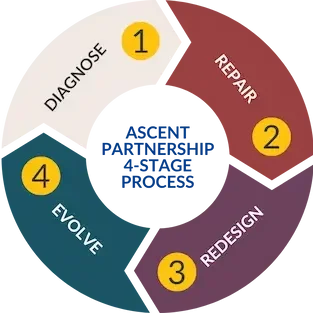
The ASCENT method moves through four phases.
DIAGNOSE — Figure out what’s actually driving the strain, and at what level. The roots before the work.
REPAIR — Deal with what’s been building up. Strained trust, things left unsaid, and what you've already tried that hasn’t worked. New agreements don’t hold on top of old hurt.
REDESIGN — Rebuild the parts that have stopped working. How you communicate, how you make decisions, and how you handle disagreement. Plus the structural pieces: build agreements that match how the business actually runs now.
Business Partners Describe the Work
Watch this video of Simone and Haley in their own words.
Like you, they had complementary skills, shared vision, and they believed they could build something extraordinary together. They were right. But real friction had surfaced about who decided what, who carried what, and what happened when they disagreed.
Coaching changed what they could do together. All of it moved faster: decisions, follow-through, the conversations they'd been putting off. Disagreement stopped costing them so much. They could hold each other accountable without making it personal. The result: doubled productivity and five years of consistent year-over-year growth.
Over 25 Years Working With Cofounders and Business Partners
I spent years in clinical counseling and collaboration consulting before transitioning into partnership work full time. For over 25 years, I’ve worked with cofounders and business partners where psychology, relationships, and how a business actually runs all meet. Now, it’s all I do.
For five solid years actively facilitating Interpersonal Dynamics at Stanford Graduate School of Business, and I've continued coaching there remotely, on and off, since.
Fit matters. I work with up to eight partnerships at a time. I want to be confident I’m the right person for what your partnership needs, and I screen for it before any engagement begins.
Based in the San Francisco Bay Area. I work with partnerships across the US, mostly remotely. In-person intensives are available in the Bay Area, Sonoma County, and Kauai.


Why You Need Outside Support
From inside the dynamic, neither of you can see the whole picture of what’s happening between you. Both of your experiences are real but neither of you can see past your blind spots to the complete picture.
Communication is not the only sticking point, or the only solution. You can be a skilled communicator and still not be able to get each other to see what you see. The pattern is bigger than what either of you can see alone. That's most of what makes this work hard. And why it rarely resolves without help.
Someone outside it can see what you can’t. And they can help you stay clear and intentional when things get charged, and find new ways to engage that help you both get your own needs, as well as those of the business, met.
What Becomes Possible
When the diagnosis is right, the repair holds, and the way you work together actually matches the business you’re running, the partnership stops draining you. It starts giving back.
The dread before certain meetings lifts. Hard conversations stop being charged and start being useful. Resentment that's been building quietly starts to lift because it gets addressed, not just smoothed over.
Decisions close. Disagreement stops costing what it used to. All the energy that was going into the workarounds, the unspoken concessions, the rehearsing before hard conversations. That comes back to the business.
The goal is simple: to stop feeling like you’re wrestling with an adversary and start working together again.
Start with the Partnership Friction Assessment
If you've been going it alone, raising the issue, watching agreements fall apart, and quietly wondering whether the problem is the partnership itself.
Free. No partner required.
Contact
Sunny Sabbini, M.A.
San Francisco Bay Area
Remote Sessions Nationwide
(415) 895-0786